


Which features will customers pay more for? Six methods compared.
Interviews, Kano, MaxDiff, conjoint, A/B test or behavioural test: each method answers a different feature question. An overview of what each one delivers and when you need measured purchase intent.

In short
- Surveys quickly show which features customers find important and how they weigh attributes against each other. They measure what people say.
- Whether a feature earns its premium only shows in behaviour: the same product with and without the feature, at different prices, with measured purchase intent per variant.
- The methods complement each other: first shorten the longlist and understand the drivers, then validate the decision on features and premium against behaviour.
What belongs in the base version, what justifies the premium variant, what can go? These questions decide development budget, tooling costs and the price list. The hard part is not whether customers like a feature, but whether they will pay more for it.
1. Interviews and qualitative research: why, not how much
Conversations with customers show which problems a feature solves and the words customers use for it. That produces good hypotheses and the language for the offer. What a feature is worth cannot be read from it: the sample is small, and willingness to pay in a conversation is a statement without consequence.
2. Kano: basic, performance or delight
The Kano model asks, for each feature, how customers react when it is present and when it is missing. This sorts features into categories: basic features whose absence annoys, performance features that satisfy more the better they are, and delighters nobody expects. Kano helps decide what belongs in the base version. It does not give a price.
3. MaxDiff: ranking the features
In MaxDiff, respondents pick the most and least important feature from changing lists. The result is a clean ranking, even with 20 or 30 features. MaxDiff is well suited to shortening a long list quickly. It does not show what premium a feature can carry.
4. Conjoint: weighing features against each other
In a conjoint analysis, respondents choose between product profiles that differ in several attributes, including price. From this, part-worths and an implied willingness to pay per feature can be estimated. Conjoint is strong when many attributes need to be weighed at once, and choice-based designs reduce hypothetical bias. The choice still remains hypothetical, and results depend heavily on the design and the selection of attributes.
5. A/B test in an existing product
If you already run a digital product, you can test a new feature or an upgrade price inside it. That measures real behaviour, but it requires the product and its customers to exist. For a physical device, or a feature that has not been built, this method is not available.
6. Feature test with measured purchase intent
Comparable groups from your target audience see the same offer in a realistic ad and on a realistic offer page, once with and once without the feature, at different prices if needed. What is measured is purchase or sign-up intent on the offer page. Nothing is sold; anyone who decides learns straight away that the offer is not available yet. This lets you test a feature before it is developed.
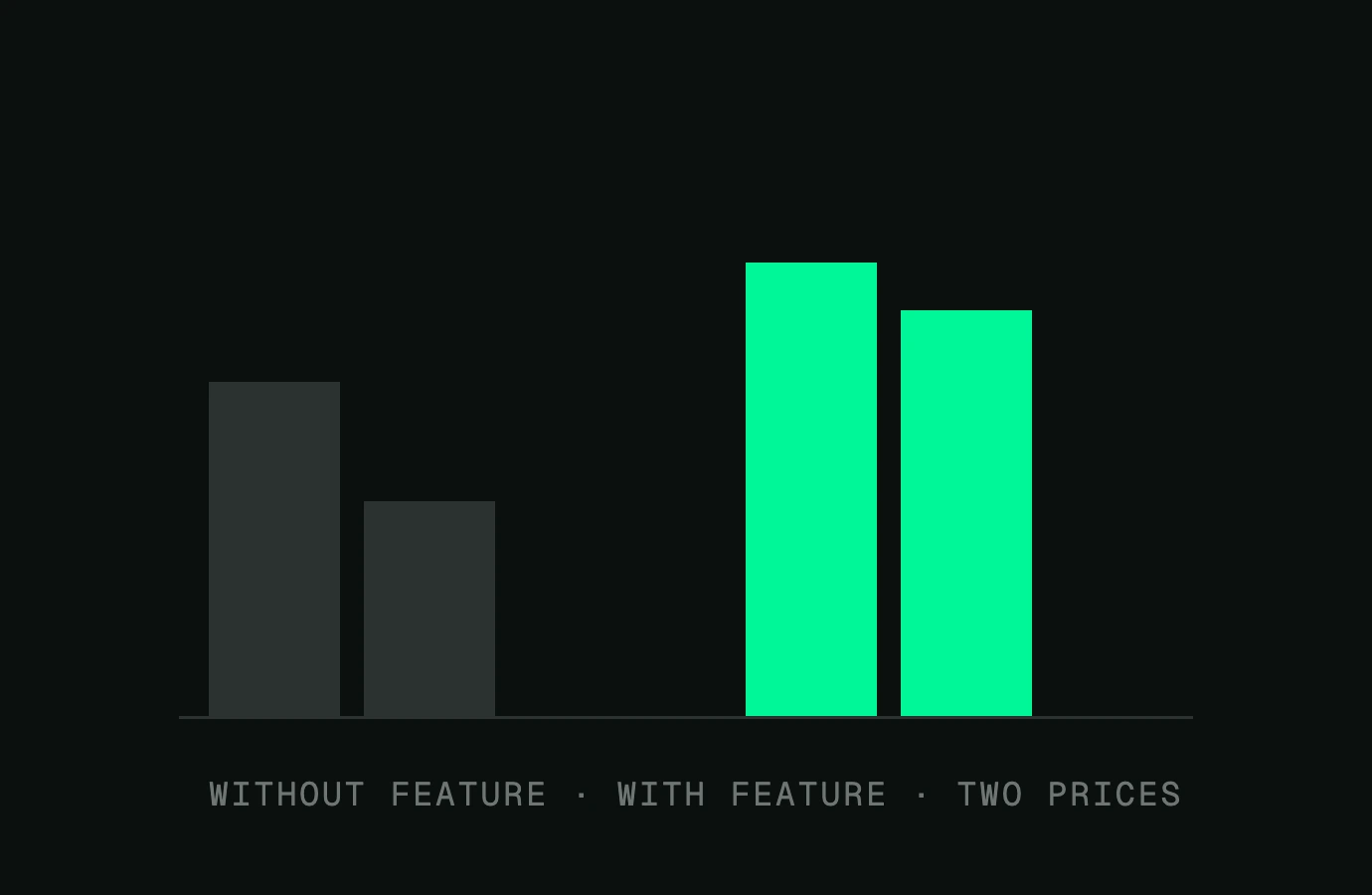
Example · Robot vacuum · measured purchase intent per variant
Without self-empty station
3.1%
€449
1.9%
€549
−39% at the higher price
With self-empty station
4.0%
€449
3.6%
€549
only −10% at the higher price
With the station, the premium costs hardly any purchase intent; without it, almost 40%. The station earns its premium.
Two rules keep the result robust. First, options that influence each other go side by side on one comparison page instead of separate variants. Second, a feature you can see in a photo, such as a colour or a material, gets its own variant with its own image; a feature you cannot see is selected on the offer page.

Which method when?
| Method | Answers | Data basis |
|---|---|---|
| Interviews | Which problem does the feature solve, how do customers talk about it? | Stated, small sample |
| Kano | Does the feature belong in the base version? | Stated |
| MaxDiff | Which features matter most? | Stated, as a ranking |
| Conjoint | What is a feature worth relative to others? | Stated, as a choice |
| A/B test in the product | Do existing customers use a new feature or upgrade? | Observed, existing product only |
| Feature test with purchase intent | Does the feature earn its premium before it is developed? | Observed |
- Long list, early phase: MaxDiff or Kano to narrow it to three to six candidates.
- Many attributes and packages at once: conjoint.
- A few specific features, and development or tooling depends on the decision: a feature test with measured purchase intent, with up to six variants.
- Defining the premium variant: the same product with and without the feature at two prices, so you see how much demand the premium costs.
From practice
Liebherr THE LAB! had four antibacterial functions for fridges in advance development and had to pick one. The test showed which function consumers added to the basket, before a prototype existed.

Four technologies for the fridge. One wins at purchase.
Liebherr THE LAB! had four antibacterial functions in advance development and budget for one. Horizon measured which function people added to the basket, before a prototype existed.
Video · English with subtitles
Limits of the behavioural test
A feature test compares a few specific variants and shows what people do, not why. How a feature affects usage and satisfaction after purchase is not visible there. Surveys and behavioural measurement are therefore not opposites: one explains, the other decides.
Frequently asked questions
How do I find out which features customers will pay more for?
Shorten the list with MaxDiff or Kano to a few candidates. Then test them as the same product with and without the feature at two prices, and measure purchase intent per variant.
Can I test a feature that has not been developed yet?
Yes. What is tested is the offer, not the product: the ad and offer page show the feature, and purchase intent is measured. No prototype is needed.
Does a feature test replace a conjoint analysis?
No. Conjoint weighs many attributes at once. A feature test validates the decision between a few specific variants against behaviour. It often follows a conjoint study.
How many features can be compared in one test?
Up to six variants. How many make sense depends on the target group and on whether you also vary the price.
About the author
Daniel Putsche
Founder and CEO of Horizon. Works with product, pricing and insights teams to base decisions on measured purchase behaviour.
Related articles





Which decision do you want to validate?
Bring your decision question, we sketch a possible test design with you. No preparation needed on your side.

You will talk to Daniel Putsche
Founder & CEO, 30 minutes