

Why customers buy differently from how they answer in surveys.
In the survey, customers say yes; at the decisive moment, they choose something else. Where the gap between saying and doing comes from, where it distorts decisions and how to close it.

In short
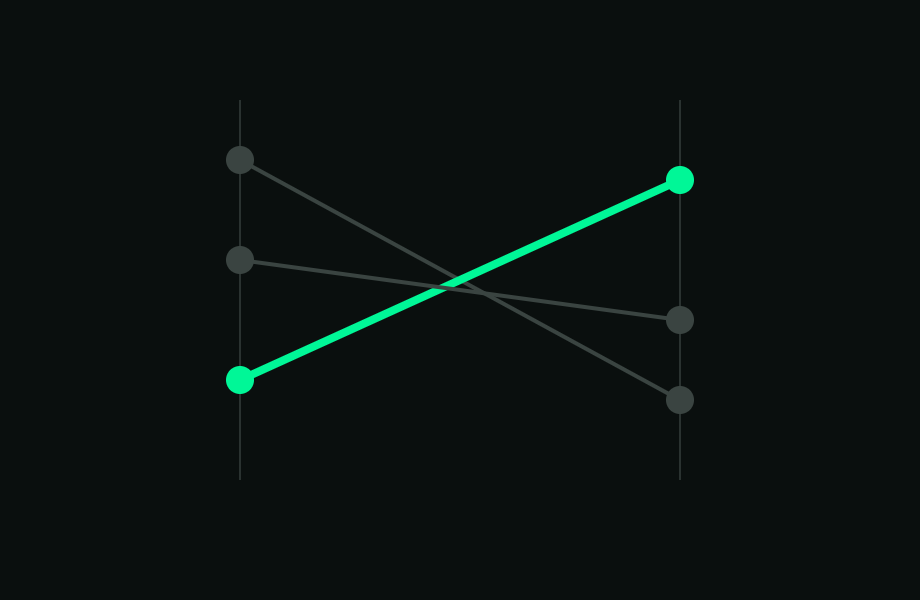
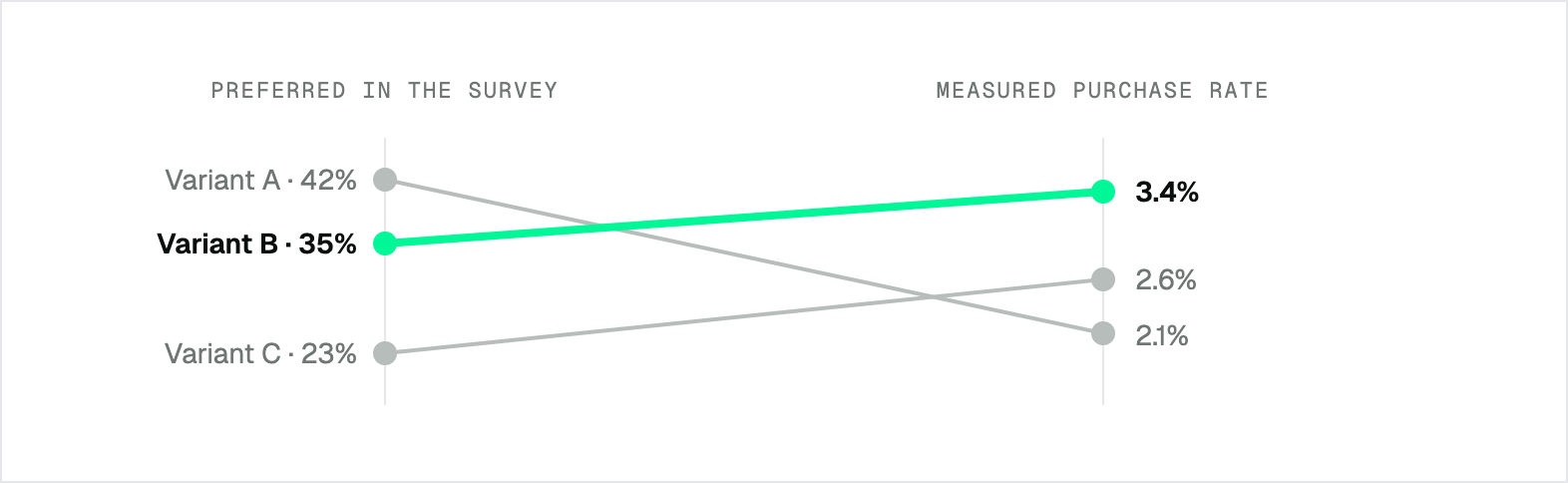
- Stated purchase intent exceeds actual purchases in many categories, and the ranking of variants can flip.
- The main reasons: the answer has no consequence, socially desirable answers, optimism about one’s own behaviour, the missing purchase situation.
- Surveys explain the why. The final decision needs measured behaviour.
A concept scores brilliantly in the survey, yet after launch demand falls short of the business case. One variant is clearly preferred in the survey, another one is bought. Research calls this the say-do gap: the gap between what people say and what they do.
What the gap means
The gap was first described for environmental behaviour, as the distance between attitude and action (Blake, 1999). But it appears wherever people report on a future decision: on prices, products, plans and messages. For companies, it is therefore not an academic detail but a risk for every decision that rests on answers rather than behaviour.
Four reasons for the gap
1. The answer has no consequence
Saying yes in a survey costs nothing. Answers are correspondingly generous: a meta-analysis of more than 100 studies shows that respondents state a willingness to pay around 20% higher than what they actually pay (Schmidt and Bijmolt, 2020).
2. Socially desirable answers
Sustainable, healthy, responsible: people like to answer the way they want to be seen. At the moment of purchase, price, convenience and habit count.
3. Optimism about one’s own behaviour
Intention is not behaviour. According to the theory of planned behaviour, attitude, social norms and perceived control shape our intentions (Ajzen, 1991). Whether an intention turns into action is only decided in the concrete situation.
4. The purchase situation is missing
A classic example: in the interview, a participant is enthusiastic about a new fruit smoothie. Afterwards, free to choose in the canteen, they take the roast pork. A survey lacks price, alternatives and effort, exactly what determines the decision in the end.
Where the gap gets expensive
- Price: the stated willingness to pay leads to a price that is too high or too low.
- Concept: overestimated demand ties up development, IT and marketing budget.
- Message: a claim is liked in the survey but does not lead to a purchase.
- Plan and offer: the preferred model is not the one customers sign up for.
How to close the gap
The way forward is to measure behaviour where it happens: on a realistic offer that people see in their familiar online environment and decide for or against. Comparable groups each see one variant; what is measured is the purchase or sign-up decision. “I would buy it” becomes an observed decision rate per variant.
This does not replace surveys. They remain the best tool for understanding motives, developing hypotheses and describing target groups. Measured behaviour complements them where the final decision is made.
Surveys explain why. Behaviour shows what gets bought.
Frequently asked questions
Does that mean surveys are worthless?
No. Surveys reveal motives and provide hypotheses. For the decision between specific variants, you complement them with measured behaviour.
How big is the gap in my category?
That depends on category, price and situation. That is why we do not measure it in general, but for your specific decision.
About the author
Daniel Putsche
Founder and CEO of Horizon. Works with product, pricing and insights teams to base decisions on measured purchase behaviour.
Related articles



Which decision do you want to validate?
Bring your decision question, we sketch a possible test design with you. No preparation needed on your side.

You will talk to Daniel Putsche
Founder & CEO, 30 minutes