

Home/Roles/ Innovation & New Business
Go or no-go with evidence that convinces.
See whether customers would buy or sign up for a concept before it gets budget. That way you bring management evidence for approval, not opinions.
Benchmark 2.8%
Concept A
4.6%
Concept B
4.1%
Concept C
3.7%
Concept D
3.3%
Concept E
1.9%
Concept F
1.4%
Six concepts, one yardstick. Illustration with sample values.
Your core question
Which concept deserves the next budget, and on what data do innovation and management decide together?
Why pipelines stay full
More ideas than ever. The hit rate stays the same.
76% of product launches miss their targets. Not because ideas are lacking, but because budget is allocated before a single customer has decided. A shared yardstick makes concepts comparable and exposes weak ones early.
Source of the 76%: BCG 2025.
Schematic timeline.
Use cases
Where Horizon helps in your pipeline.
From the first concept to approval: evidence that management and business units understand without translation.
01
Test concepts early
Does an idea have enough demand before development and the business case are committed?
02
Prioritise the portfolio
Six ideas, one yardstick: which deserve to be built?
03
New business models
Subscription, rental or platform: what do customers choose?
04
Prepare approval
Results that justify budget to management.
Stage-Gate
A gate for willingness to buy. Right after the idea.
Classic concept tests come late and ask how much people like a concept. Horizon starts earlier: even with first concepts and simple visuals, you see whether customers would buy. What does not resonate drops out before elaboration and development tie up budget.
01
Idea
Search fields, trends, first hypotheses.
02 · Horizon gate
Willingness to buy
First concepts, simple visuals: would customers buy? What resonates, what does not?
03
Refinement
Only with the concepts customers would buy.
04
Development
Prototype, engineering, business case.
05
Launch
Production, sales, market launch.
Filter out early, before it gets expensive.
Mature innovation processes stop weak concepts before they are elaborated. Every idea that ends here ties up no development budget.
Criteria everyone knows in advance.
Innovation, management and development agree together on the level of purchase intent at which a concept moves forward. The gate decides on data, not opinion.
Test neutrally, refine later.
Early tests run under a neutral test brand, with no link back to your company. You refine price, target groups and regions later under your own brand.
How a test works
A robust decision in four weeks.
Your effort: concept descriptions, first visuals and four short meetings. The Horizon team takes care of the rest.
Week 1
Question and variants
You bring your concepts, we sharpen the question and define up to six variants.
Week 2
Ads and offer pages
Horizon builds realistic ads and offer pages, with your brand or a brand developed specifically for the test.
Week 3
7 days in field
Your target group sees the offer in their familiar online environment and decides. You follow everything live.
Week 4
Result and data analysis
Purchase or sign-up intent per variant, statistically robust, as a data analysis for your decision.
During the test
Results in real time.
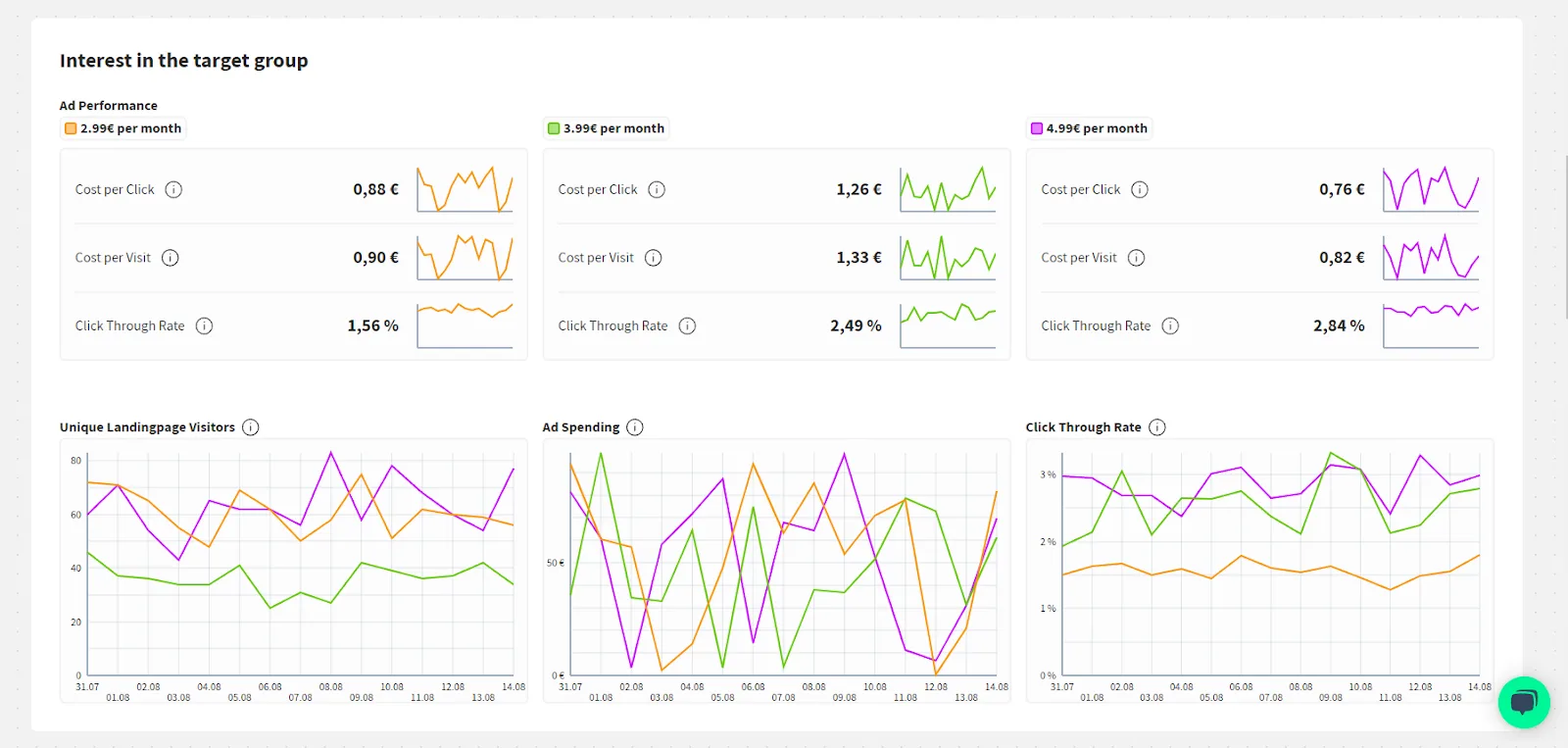
During the field phase you see live how your target group decides. All metrics per variant, from ad click to purchase or sign-up intent.
Cost per click, click-through rate and visitors per variant
Purchase or sign-up intent with statistical validation
Benchmarking against comparable tests
After the test
What your result looks like.
This is what a Horizon results report looks like: question, variants, purchase or sign-up intent and data analysis on just a few pages.
Concept test pet food
napfwerk · Example
+79%
B versus A
2 of 3
above benchmark
The fresh food box achieves the highest purchase intent.
Example values
Case · Leading appliance manufacturer
New development versus bestseller: clear demand before launch.
An appliance manufacturer wanted to know whether a newly developed product had enough demand before going into series production. The yardstick: its own, already successful product.
3,230
consumers
3 days
in field
5.7x
cheaper per basket
Cost per basket (lower is better)
New product · $39.99
$4.58
Existing product · $59.99
$26.33
The new product generates demand at a fraction of the cost, with a higher contribution margin per unit ($35.41 instead of $33.66).
FAQ
Frequently asked questions.
At what stage can an idea be tested?
As soon as there is an image, a value proposition and a price. No prototype is needed.
Is anything actually sold?
No. No contract is concluded and no payment is taken. Anyone who chooses an offer is informed transparently afterwards.
How long does a test take?
Around four weeks from question to data analysis, depending on the target group and the number of variants.
Can the test run without our brand?
Yes. You test with your brand or a brand developed specifically for the test, so you do not reveal a new idea too early.
Let's talk about your next decision.
You bring your concepts, we sketch a possible test design. No preparation needed on your side.

You will speak with Daniel Putsche
Founder & CEO, 30 minutes
Read more