

AI features or reliability: what home appliance buyers pay for.
Appliance launches lead with intelligence. Buyers name long-term reliability as their main purchase driver and smart features near the bottom. What the 2026 evidence shows and how to settle the question before tooling.


In short
- 46% of buyers name long-term reliability as their main purchase driver for home appliances, 2% name smart features (Curion, n = 2,676).
- Connected appliances report more problems, and a problem sharply lowers repurchase intent (J.D. Power).
- Which option buyers choose shows in a test before tooling: with a control without AI and a constant price.
Over the past year, flagship appliances have led with AI. Samsung launched its Bespoke AI range in 2025 and extended it at KBIS 2026. KitchenAid showed a wall oven with a cooking camera that recognises food and adjusts cook time. Xiaomi sells an air conditioner with an AI energy-saving mode.
The industry bets on AI, buyers on reliability
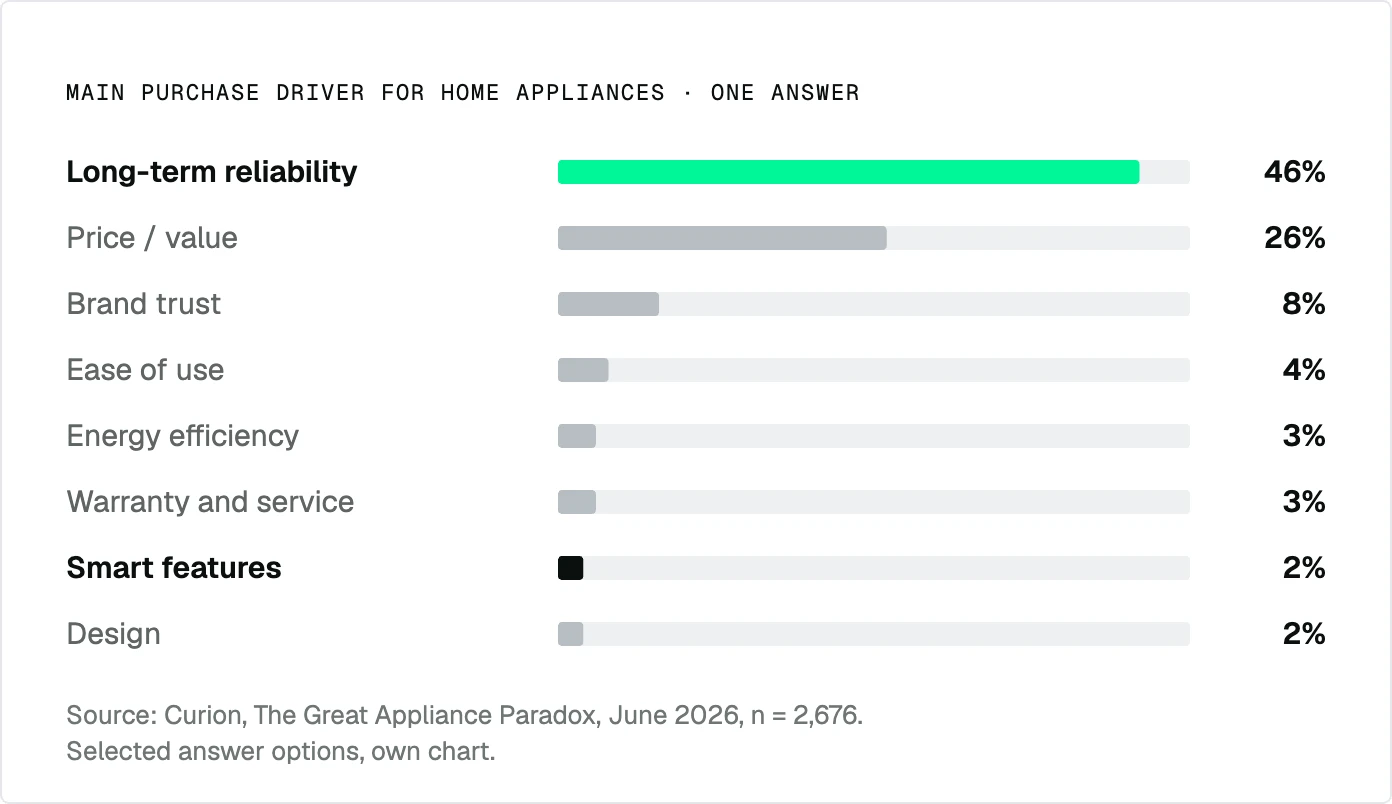
In a poll published in June 2026, Curion asked 2,676 consumers for their primary driver when buying a home appliance. Long-term reliability came first with 46%. Price and value followed with 26%, brand trust with 8%. Smart features reached 2%, the same as design.
Three findings worth a second look
1. Reliability and value decide most purchases
Together they account for 72% of first choices in the Curion poll. McKinsey reports the same direction in white goods: consumers rank durability, efficiency and affordability above advanced or connected features.
2. Connectivity can work against reliability
J.D. Power counts 63 problems per 100 non-connected appliances in the first years of ownership and 87 per 100 connected ones. Owners who use the connected features report 92. After a problem, the share who will definitely buy the same brand again falls from 52% to 32%. Consumer Reports found that only 3 of 21 brands state how long their smart appliances will receive software support.
3. Loyalty is thin, so the next purchase is open
Only 11% of Curion respondents are loyal to one or two brands. 35% say they are open to switching for better value. Just 7% describe themselves as driven by the latest innovation. McKinsey adds that the share of owners who keep appliances for ten years or more rose from 35% to 39% in a year, so each purchase decision carries further.
This is not a case against innovation. NIQ names energy efficiency as the leading purchase driver for major appliances, and 74% of consumers would prefer appliances with health and wellness features. A feature earns its place when it does a job the buyer recognises.
Briefing · 8 pages · PDF, English
What decides an appliance purchase
All studies, figures and sources on eight pages: Curion, J.D. Power, McKinsey, NIQ and Consumer Reports, plus the regulatory timeline and three steps for feature decisions before tooling.
Download the briefingWhy this becomes urgent now
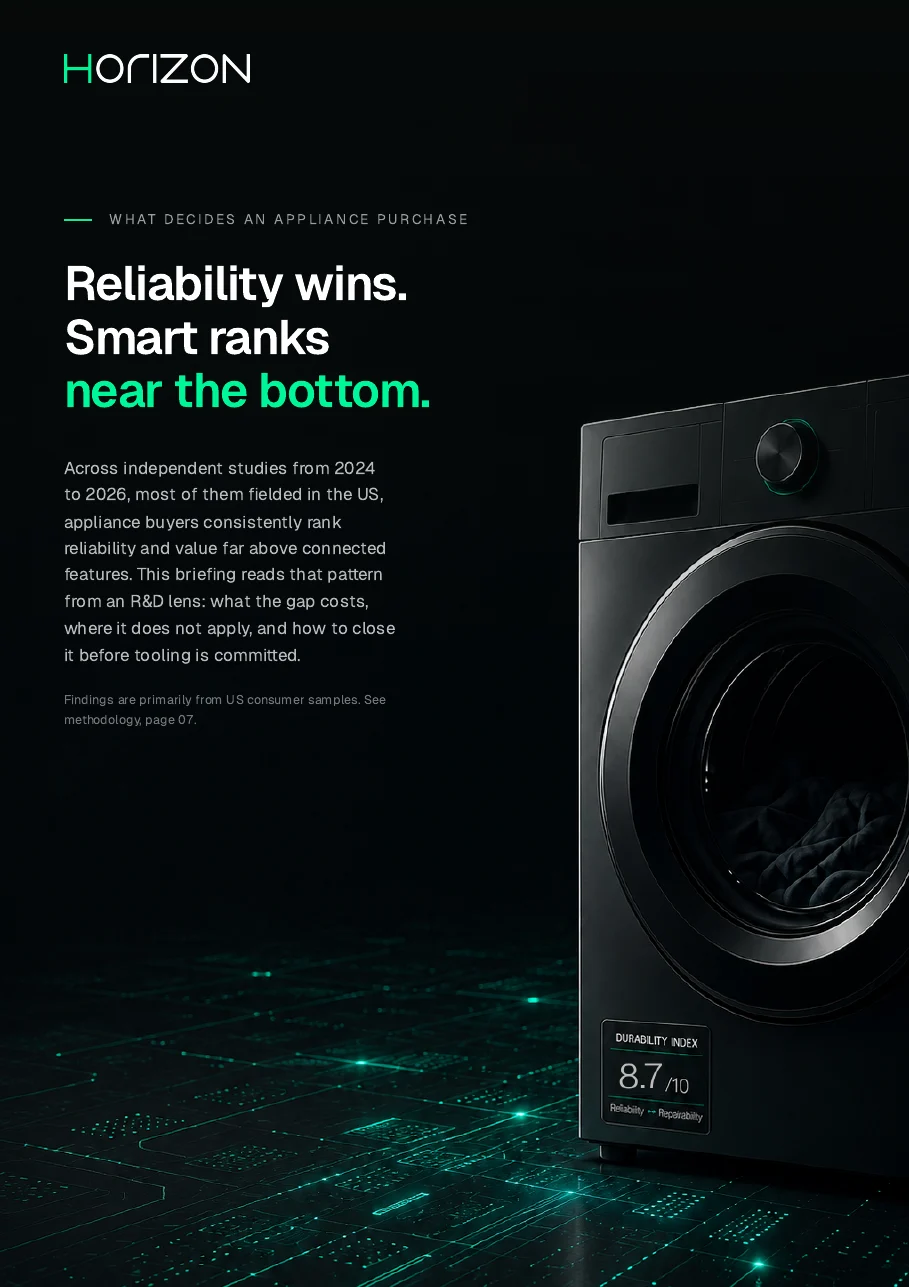
Durability is turning into a comparable claim. Since 8 April 2025, every washing machine sold in France carries an indice de durabilité, one score out of ten for reliability and repairability. EU member states have applied the Right to Repair Directive since 31 July 2026. Spare parts for washing machines must already be available for at least ten years. The EU is working towards repairability scores for more product groups.
On a development cycle of 12 to 24 months, a feature chosen today meets a market where durability is shown at the point of sale.
How to decide before tooling
Surveys like Curion’s show what buyers say drives them. They are the right starting point. What they cannot show is which of two concrete options buyers choose when both are in front of them. That is a test-design question, and it can be answered before a prototype exists. Three principles for the next appliance test:
- Keep one variant without the AI feature. A control on today’s standard shows what the feature adds. Without it, you measure category demand.
- Run the durability proposition against the AI proposition. Frame durability the way a label will: a score, ten years of parts, a documented lifespan. Then let it compete with “does more”.
- Hold the price constant across variants. Then the difference in measured purchase intent belongs to the proposition. Vary price only when willingness to pay is the question.
Example: four technologies, budget for one

Four technologies for the fridge. One wins at purchase.
Liebherr THE LAB! had four antibacterial functions in advance development and budget for one. Horizon measured which function people added to the basket, before a prototype existed.
Video · English with subtitles
Sources
- Curion, The Great Appliance Paradox (2026)
- J.D. Power, 2025 U.S. Appliance Reliability & Service Study
- McKinsey, What’s trending in white goods (2025)
- NIQ, Home Appliances Outlook 2026
- Consumer Reports, When Will Your Smart Appliance Turn Dumb? (2024)
- Décret n° 2024-316 (FR)
- Directive (EU) 2024/1799
- Regulation (EU) 2019/2023
Frequently asked questions
Are AI features in home appliances unnecessary?
No. Features that do a job buyers recognise, such as energy efficiency, contribute to the purchase. Which ones that is for your product, a test shows.
How reliable are the Curion figures?
Curion polled 2,676 consumers. The study shows what buyers name as their purchase driver. Which of two concrete options they choose is shown by a behavioural test as a complement.
How do I test a feature before it is developed?
Each variant gets a realistic offer page that comparable groups see in their familiar online environment. Measured purchase intent per variant shows the result before a prototype exists.
What does the right to repair change for appliance makers?
Durability becomes comparable: in France as a score on washing machines, in the EU through spare-parts obligations and the Right to Repair Directive. A durability proposition can therefore be tested against an AI proposition today.
About the author
Daniel Putsche
Founder and CEO of Horizon. Works with product, pricing and insights teams to base decisions on measured purchase behaviour.
Related articles




Which decision do you want to validate?
Bring your decision question, we sketch a possible test design with you. No preparation needed on your side.

You will talk to Daniel Putsche
Founder & CEO, 30 minutes