

How freenet decided which argument goes to its customers
Three stories, one thread: decisions that usually get made on assumptions.
In this issue
Three stories this month, one thread: decisions that usually get made on assumptions. How freenet let its customers pick the argument for an add-on instead of deciding in a meeting. How to plan demand for a product nobody has seen yet. And a guest lecture in Munich with the CEO of Versicherungskammer Bayern on where decisions go wrong.
Daniel Putsche, Founder & CEO, Horizon
The argument you'd bet on is probably the wrong one. How freenet found out before the rollout

freenet wanted to offer its mobile customers add-on protection for smartphone, data and travel. Three arguments were on the table: social proof, a needs check and Cashback. Instead of deciding in a meeting, freenet let more than half a million customers decide. One argument brought 3.4 times the purchase intent of Cashback. The needs check drew twice as many visitors as Cashback, yet fell furthest behind on purchase intent.

Anything that is truly new strategy belongs in a test with real customer behaviour first. Our core question in this test was whether customer-centric messaging creates more demand than product-centric messaging, and we clearly proved it.
Anke Schramm, Head of Research and Improvement, freenet
See which argument won, and why →
You can't plan demand for a product nobody has seen. Or can you?
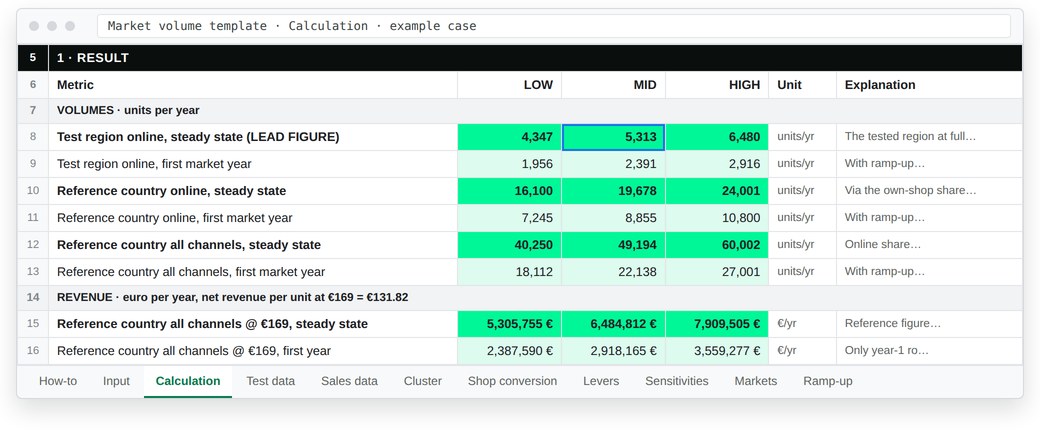
A new product has no sales history, so its volume plan rests on substitutes: look-alike products and their past sales, third-party market data, and judgment from surveys, concept tests and internal planning rounds. Each answers a different question. Look-alikes assume the new product sells like the old one, market data describes the category, surveys capture what people say.
None of them shows how customers respond to this product at this price. Yet that number drives production runs, listings and the business case. A test adds the missing input: measured purchase intent for products that do not exist yet. Our free template shows how it flows into your plan.
Where decisions go wrong: a guest lecture with the CEO of Versicherungskammer Bayern

Prof. Dr. Frank Walthes, CEO of Versicherungskammer Bayern, one of Germany's largest insurance groups, invited Horizon into his lecture at WERK1 in Munich, together with the InsurTech Hub Munich. Together we talked about how decisions go wrong when they rest on assumptions nobody checks, from building a company to launching a product. It is the same conversation we have with leadership teams across insurance, energy, telco and consumer goods. Thank you for the invitation, it was a pleasure.
Which decision would you rather settle with your customers than in a meeting?
Bring us the decision you are least sure about. We sketch how to test it, no preparation needed on your side.